
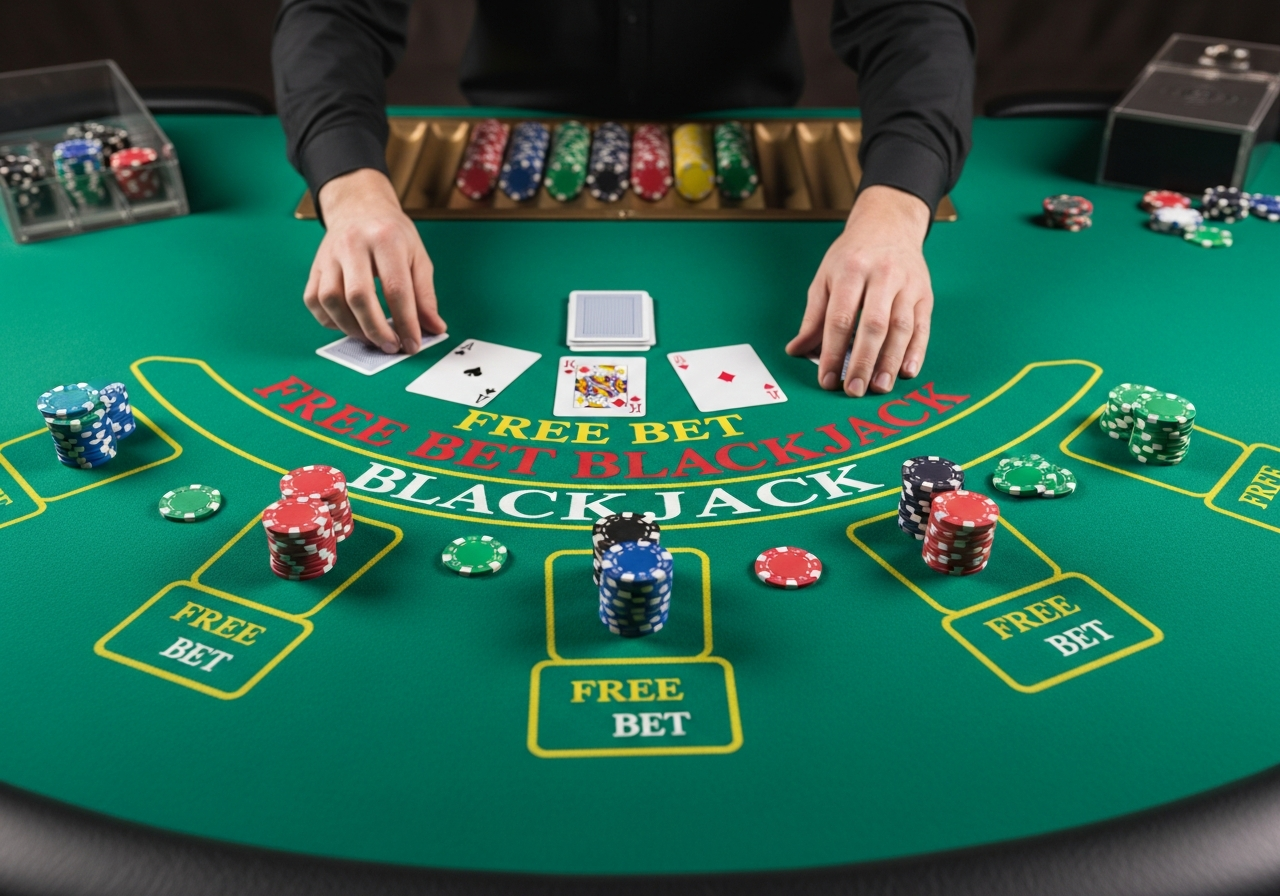
Free Bet Blackjack has become a popular variant in Indian live casinos, offering players a unique twist on traditional blackjack through casino-funded doubling and splitting opportunities. Unlike classic blackjack, where every strategic move costs you additional money from your original bankroll, Free Bet Blackjack grants certain doubles and splits at no extra cost—the house provides a “free-bet” marker to cover the wager. However, this apparent player advantage comes with offsetting rules, most notably the dealer 22 push mechanic, which can dramatically alter hand outcomes compared to standard blackjack.
Understanding Free Bet Blackjack rules is essential for Indian live casino players because rule variations exist across operators—there is no single universal standard. What qualifies as a “free split” or “free double,” how many times you can resplit, whether the dealer hits soft 17, and how blackjack payouts are structured all differ from one live casino platform to another. This guide walks you through the core mechanics, strategic adjustments, and practical verification steps you need to confidently play Free Bet Blackjack at Indian live tables.
What Free Bet Blackjack Is in Indian Live Casinos
Free Bet Blackjack is a blackjack variant where the casino funds certain strategic plays—primarily doubles on specific hand totals and splits on qualifying pairs—rather than requiring you to risk additional money. The fundamental objective remains unchanged: achieve a hand total closer to 21 than the dealer without exceeding 21. However, the rule changes fundamentally alter hand value, expected outcomes, and optimal play decisions.
How the free-bet mechanic works
When you place an initial wager and your hand qualifies for a free double or free split, the casino automatically places a free-bet marker (or credit) alongside your original bet rather than asking you to match your wager. If your free-bet hand wins, you are paid as if you had wagered real money—meaning a winning free double on 11 against a dealer 5, for example, yields full payment on that doubled total. If your free-bet hand loses or pushes, you generally lose only your original wager; the free-bet portion is not additionally charged against your account.
This structure is critical: the “free” element means the house absorbs the cost of the additional bet when you win, but you still collect full winnings on that hand. However, the loss scenario is nuanced—your original bet remains at risk, and the free bet’s loss does not further deplete your balance beyond the original bet.
How it differs from classic blackjack
Free Bet Blackjack introduces several rule deviations that distinguish it sharply from standard blackjack. The most impactful are free splits and doubles, restrictions on which pairs you can split, limits on resplitting, the dealer 22 push rule, and variations in blackjack payouts.
| Rule area | Classic blackjack | Free Bet Blackjack |
|---|---|---|
| Doubling on 10, 11 | Player pays full double wager | Dealer provides free-bet marker for qualifying totals (e.g., hard 9, 10, 11) |
| Pair splits | Player pays full split wager | Certain pairs (e.g., 8s, 9s) split for free; others may have restrictions |
| 10-value pairs (10-10, K-K, etc.) | May split for cost | Typically not eligible for free split; splitting costs full wager |
| Dealer 22 total | Dealer busts; player wins | Usually results in push against all non-blackjack hands |
| Split and resplit limits | Typically up to 4 hands | Often capped at 3–4 hands; aces may be restricted to one card each |
| Insurance availability | Standard offering | Varies by operator; sometimes removed or modified |
Core Table Rules and Hand Values
Standard blackjack mechanics form the foundation of Free Bet Blackjack. Card values, blackjack payouts, deck composition, and dealer behavior follow familiar patterns, though operator variation is common in live casino environments.
| Rule | Typical rule | Why it matters |
|---|---|---|
| Card values | Number cards 2–9 = face value; 10, J, Q, K = 10; Ace = 1 or 11 | Determines hand totals and strategic decisions |
| Blackjack payout | 3 to 2 (standard) or 6 to 5 (varies by operator) | 3 to 2 is preferable; 6 to 5 reduces blackjack profitability |
| Deck composition | Single, double, 6-deck, or 8-deck shoe | More decks slightly increase house edge |
| Dealer soft 17 rule | Hit or Stand (varies by table) | Dealer hitting soft 17 slightly favors the house |
| Number of decks | Typically 6 or 8 decks in live casinos | Affects card counting futility and edge calculations |
| Bust behavior | Player or dealer busting results in immediate win or loss | Standard across all variants |
Standard blackjack mechanics that still apply
Aces retain their dual value (1 or 11), face cards remain worth 10, and number cards equal their pip value. The objective is to build a hand closer to 21 than the dealer without busting. The dealer’s upcard is revealed first; after you make your initial decisions (hit, stand, double, or split), the dealer completes their hand according to house rules—usually hitting on 16 or less and standing on 17 or higher.
The dealer’s hole-card procedure in live casinos typically follows a standard format: the hole card is inspected or revealed only after you’ve completed your play. Soft 17 behavior (whether the dealer hits or stands on Ace-6) varies by operator and should be verified before playing. These foundational elements remain consistent across Free Bet Blackjack tables, but the strategic layer added by free options and the 22 push rule requires careful attention.
Free Splits, Re-splits, and Pair Restrictions
Free Bet Blackjack pairs certain hand combinations with no-cost splitting opportunities, making pair splitting strategy diverge from classic blackjack. However, not all pairs qualify, and resplitting is often restricted.
- Aces: Usually eligible for free split; often receive only one additional card per split (operator-dependent)
- Eights: Almost always eligible for free split (splitting 8-8 against any dealer card is strategically sound)
- Nines: Typically eligible for free split, particularly against dealer 2–9
- Fours, Fives, Sixes, Sevens: Vary by operator; some tables allow free splits on 4s and 6s, others do not
- 10-value pairs (10-10, J-K, Q-Q, K-K): Rarely eligible for free splits; usually require a paid split if available at all
- Twos and Threes: Less common as free-split candidates; varies significantly by casino
Which pairs can be split for free
The most universally free-split pairs across Indian live casinos are aces, eights, and nines. These splits align with basic strategy—splitting 8-8 against any dealer card avoids the weak total of 16, while splitting aces maximizes the potential for blackjack. However, eligibility extends differently across operators.
| Pair type | Free split allowed? | Notes |
|---|---|---|
| Aces | Yes | Usually split freely; often limited to one card per ace (no double-down on split aces) |
| Eights | Yes | Almost universally free-split; strategically sound against all dealer upcards |
| Nines | Yes | Often free; especially strong against dealer 2–9, weaker against dealer 10/Ace |
| Fours | Varies | Some operators allow; others do not; check table rules |
| Sixes | Varies | Operator-dependent; less common as free-split pairs |
| Sevens | Varies | Uncommon as free-split candidates; verify at your table |
| Fives | No | Typically not split (even paid); mathematically unsound |
| Tens/10-value pairs | No | Rarely free; usually excluded to balance house edge |
| Twos and Threes | No | Uncommon as free-split options |
Re-split limits and ace handling
Most Indian live casinos cap the total number of split hands at three or four, depending on the operator. This means if you split 8-8 and then split one of the resulting eights again (receiving another 8), you can form a third hand—but further splits are typically blocked. Aces are treated more restrictively: when you split aces, you almost always receive only one additional card per ace, preventing the formation of soft 17 or other multi-card ace hands. These limits are crucial because they prevent unlimited re-splitting scenarios that would heavily favor the player.
Free Doubling Rules and Allowed Totals
Free doubling applies to specific hard totals, most commonly hard 9, 10, and 11. Unlike free splits, which are triggered by holding a paired hand, free doubling eligibility depends on your two-card total at the moment you decide to double down.
| Hand type | Free double allowed? | Common condition |
|---|---|---|
| Hard 9 | Often yes | Against dealer 2–6; some operators restrict further |
| Hard 10 | Usually yes | Against most dealer upcards; occasionally restricted to dealer 2–9 |
| Hard 11 | Almost always yes | Against most dealer upcards (sometimes excluding dealer Ace) |
| Hard 12–16 | No | Not eligible for free doubling at most tables |
| Soft 13–18 (Ace-2 through Ace-7) | Usually no | Free doubling rarely applies to soft totals |
| Soft 19+ (Ace-8 or higher) | No | Standing is typical; doubling is uncommon and paid |
| 21 (before hitting) | N/A | Play is complete; no doubling option |
When a double is free versus paid
When you hold a hard 9, 10, or 11 and the dealer’s upcard permits, the live dealer or digital interface will typically prompt you with a “free double” option, displaying a free-bet marker. You confirm the action, and the house-funded marker is placed. If your doubled hand wins, you receive payment as if you’d wagered real money. If it loses, your original wager is at risk.
- Hard 9 against weak dealer cards (2–6): Often triggers a free double prompt
- Hard 10 across most dealer upcards: Generally qualifies for free doubling
- Hard 11 versus any upcard: Usually the strongest free double candidate
- Soft totals: Typically do not qualify for free doubling; doubling soft hands usually costs real money if available
- Boundary cases: Hard 12–16 and soft 19+ are usually excluded; verify at your table
Dealer 22 Push Rule and Its Impact
The dealer 22 push rule is the primary mechanism casinos use to offset the player advantage created by free splits and doubles. When the dealer’s hand totals exactly 22 (for example, 10-7-5 or K-5-7), nearly all non-blackjack player hands result in a push—neither win nor loss. This rule fundamentally changes outcome distributions.
| Dealer outcome | Effect on player hands | Exception |
|---|---|---|
| Dealer busts (22+) in classic blackjack | Player wins all active hands | N/A |
| Dealer reaches 22 in Free Bet Blackjack | Most non-blackjack hands push | Player blackjack (natural 21) often still wins |
| Dealer total 17–21 | Standard win/loss applies | No change from classic blackjack |
| Dealer total 16 or less | Dealer hits or busts per rules | No change from classic blackjack |
How push 22 changes outcomes
In classic blackjack, if you stand on 18 and the dealer goes over 21, you win. In Free Bet Blackjack, if you stand on 18 and the dealer reaches exactly 22, your hand pushes—you neither win nor lose. This seemingly minor change has profound implications: hands you would win in standard blackjack become neutral outcomes. Over time, this reduces your win rate on hands that would otherwise beat the dealer through bust avoidance.
The push 22 rule typically applies universally to all non-blackjack totals. However, some operators distinguish between player blackjack (a natural 21 dealt in the first two cards) and other 21 totals. A player blackjack usually wins even against dealer 22, while a player hand totaling 21 through other means might push. Always verify your operator’s specific ruling.
Why casinos use the 22 push rule
The house uses the push 22 mechanism because free splits and doubles would otherwise create an unacceptable player advantage. By converting some winning hands into pushes, the casino rebalances the expected value. This is not punitive—it is simply how the game is mathematically structured. The free-bet options and the 22 push rule are counterweights; removing either one substantially shifts the game’s profitability profile.
Side Bets, Insurance, and Even Money Options
Free Bet Blackjack tables may offer additional wagering opportunities separate from the main hand, including insurance, even money, and operator-specific side bets. These are optional and should be evaluated carefully.
- Insurance: Offered when the dealer shows an Ace, allowing you to wager up to half your original bet that the dealer has blackjack. Insurance typically pays 2 to 1 but is mathematically unfavorable over time.
- Even Money: Available when you have blackjack and the dealer shows an Ace. Taking even money guarantees a 1-to-1 payout rather than risking the 3-to-2 blackjack payout if the dealer does not have blackjack. Mathematically, this is a poor long-term choice.
- Operator-specific side bets: Some Indian live casinos offer proprietary side bets such as “Bust It,” “Dealer Bust,” or “Player Hand Bonus,” which pay based on specific outcomes. These typically carry higher house edges than the main game.
| Side bet/option | Availability | Key rule |
|---|---|---|
| Insurance | Common; offered when dealer shows Ace | Pays 2 to 1; mathematically unfavorable long-term |
| Even Money | Common; offered with player blackjack and dealer Ace showing | Guarantees 1 to 1; generally not recommended vs. 3 to 2 payout |
| Bust It | Varies by operator | Pays bonus if dealer busts; house edge typically 5%+ |
| Dealer Bust | Sometimes available | Wagers on whether dealer will bust; varies by payout |
| Perfect Pairs / 21+3 | Rare in Free Bet variant | Side bets on hand composition; high house edge |
Strategy Adjustments for Free Bet Blackjack
Free Bet Blackjack’s rule changes necessitate strategy deviations from classic blackjack basic strategy. Because certain doubles and splits are free, and because the dealer 22 push rule exists, decisions that would be neutral or negative in standard blackjack become favorable (or vice versa).
Common strategy differences from standard blackjack
| Situation | Classic blackjack play | Free Bet Blackjack play |
|---|---|---|
| Hard 9 vs. dealer 2–6 | Double (costs wager) | Double for free without hesitation |
| Hard 9 vs. dealer 10 or Ace | Hit or stand cautiously | Paying double is usually suboptimal; hit instead |
| Hard 10 vs. dealer 9–Ace | Double with caution or hit | Double for free if available; if paid, hit instead |
| Hard 11 vs. any dealer card | Double (standard) | Double for free—strongest free double candidate |
| Pair of Aces | Split for cost | Split for free; always split aces |
| Pair of Eights | Split for cost | Split for free; always split eights |
| Pair of Nines vs. dealer 2–9 | Split (standard) | Split for free; even stronger incentive |
| Pair of Nines vs. dealer 10, Ace, 7 | Stand or split cautiously | Avoid free splitting; stand or assess expected value |
| Soft 13–18 vs. dealer 5–6 | Double (costs wager) | Usually cannot double for free; paid doubling is weak; hit instead |
| Soft 19–21 | Stand (standard) | Stand; doubling is paid and generally weak |
Mistakes players make at live tables
- Assuming all tables use identical rules: Free split and double eligibility vary across operators; always read the table lobby or chat rules before sitting.
- Ignoring the push 22 rule: Forgetting that your 18 or 19 may push against dealer 22 leads to overconfidence in otherwise-winning hands.
- Misunderstanding free double eligibility: Attempting to double on hard 12–16 or soft totals, expecting them to be free when they are not.
- Not checking dealer soft 17 behavior: Whether the dealer hits or stands on soft 17 subtly changes basic strategy; confirm this before playing.
- Splitting 10-value pairs: Splitting 10-10 or K-K is mathematically unsound; these hands are rarely eligible for free splits anyway, and paid splits are even worse.
- Taking insurance or even money: These are side bets with negative expected value; avoiding them consistently improves your results.
- Failing to verify blackjack payout: Confirm whether blackjack pays 3 to 2 (standard and preferable) or 6 to 5 (reduces your profitability).
How to Read the Rules Before You Play
Before sitting at a Free Bet Blackjack table in an Indian live casino, take 60 seconds to verify table-specific rules. Most live platforms display rules in the table lobby, help section, or game menu.
| Checkpoint | What to verify | Why it matters |
|---|---|---|
| Blackjack payout | 3 to 2 or 6 to 5? | 3 to 2 is standard and preferable; 6 to 5 reduces profitability |
| Dealer soft 17 | Does dealer hit or stand on soft 17? | Hitting favors the house slightly; affects strategy decisions |
| Free split eligibility | Which pairs are free? (Aces, 8s, 9s, others?) | Determines when to split without cost |
| Free double eligibility | Which totals are free? (Hard 9, 10, 11 only?) | Determines which doubles are cost-free |
| Resplit limits | Can you split again after an initial split? | Affects maximum hands and strategic flexibility |
| Ace handling after split | Do split aces receive one card or multiple? | Limits soft hand potential after splitting aces |
| Push 22 rule | Does dealer 22 push non-blackjack hands? | Critical for outcome assessment and strategy |
| Side bets available | Insurance, even money, proprietary side bets? | Helps you avoid mathematically weak optional wagers |
Pre-game checklist for rule verification
- Locate the rules tab or help menu on the live casino platform; usually displayed as “?” or “Rules” next to the table name.
- Confirm blackjack payout: Look for “Blackjack Pays” or “Natural 21 Payout”—ensure it says 3 to 2, not 6 to 5.
- Check dealer soft 17 rule: Search for “Dealer Hits Soft 17” or similar language; note whether it applies.
- Verify free split pairs: Look for a “Free Splits” or “Pair Splitting” section; confirm which pairs (aces, eights, nines, etc.) trigger free-bet markers.
- Identify free double conditions: Look for “Free Doubles” or “Free Double Down”; confirm whether hard 9, 10, and 11 are listed and under what dealer-upcard conditions.
- Check resplit and ace limits: Confirm the maximum number of hands allowed after resplitting and whether split aces receive one or multiple cards.
- Confirm push 22 behavior: Search for “Dealer 22,” “Push 22,” or “Tie” rules; verify that non-blackjack hands push when the dealer totals 22.
Once you have verified these seven points, you are prepared to make informed decisions at that table. If the rules are unclear, use the live chat feature to ask the dealer or support team; most Indian live casinos provide real-time rule clarification.
Free Bet Blackjack offers an engaging alternative to classic blackjack by funding strategic plays that would otherwise cost real money. However, the rule variations across Indian live casinos—especially concerning free split and double eligibility, the push 22 rule, and resplit limits—require player diligence. By understanding the mechanics, recognizing how they differ from standard blackjack, adjusting your strategy accordingly, and verifying table-specific rules before placing bets, you maximize both your enjoyment and your expected value at the table.