
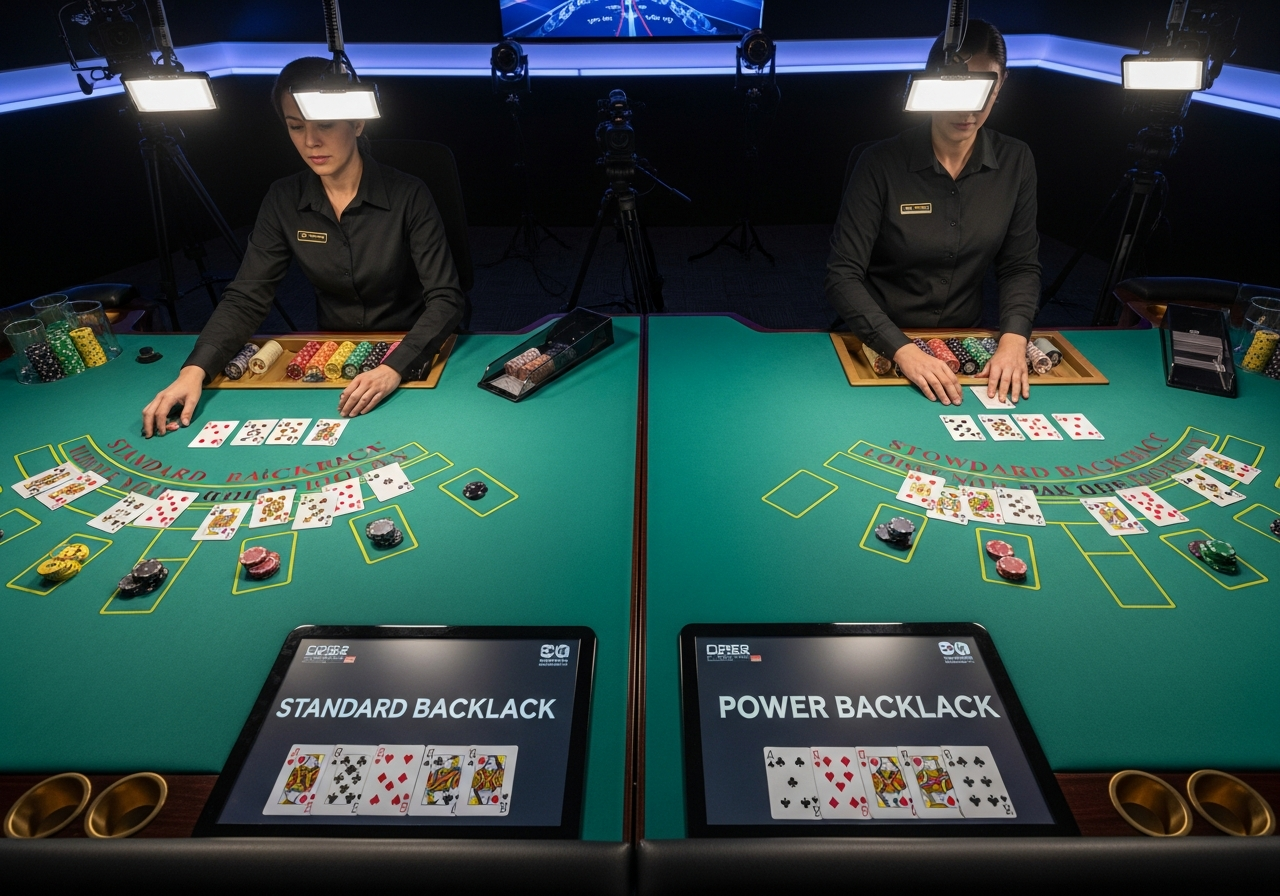
Live blackjack has exploded across India’s online gambling landscape, with platforms offering everything from classic tables to innovative variants that promise higher volatility and more exciting payouts. Among the newer offerings gaining traction with rupee-playing enthusiasts is Power Blackjack—a modern twist on traditional blackjack that introduces rule changes, altered deck compositions, and enhanced betting mechanics. Understanding how Power Blackjack differs from standard blackjack is crucial for Indian players deciding which variant suits their risk tolerance, bankroll and playing style.
This guide delivers a detailed, rule-by-rule comparison of Power Blackjack and standard blackjack as they’re offered in India’s live casino ecosystem. You’ll discover how deck composition, payouts, doubling and splitting rules, and strategy fundamentals diverge between the two—with practical examples in Indian rupees and real-world table conditions. Whether you’re a beginner exploring live dealer games or an experienced player considering a switch to higher-volatility variants, this breakdown will clarify which game aligns with your goals.
Standard Blackjack Basics for Indian Players
Standard blackjack remains the foundation of live casino offerings in India. Indian online casinos typically feature live dealer blackjack tables hosted from studios in jurisdictions like Malta, Philippines, or Curacao, where dealers conduct games in English and often Hindi, accommodating rupee players with betting ranges from ₹100 to ₹50,000+ per hand. The rules Indian players encounter are generally consistent with international standards, though individual platforms may apply minor variations—such as whether the dealer hits a soft 17 or stands, and whether surrender is offered.
Core Rules and Flow of a Classic Hand
A standard blackjack hand unfolds in a predictable sequence. Here’s how a typical round plays out:
- Place your bet – You decide your wager in rupees before cards are dealt. Most Indian tables allow minimum bets of ₹100–₹500 and maximum bets of ₹10,000–₹50,000, depending on the platform and table tier.
- Receive initial cards – You and the dealer each get two cards face-up. Your goal is to reach a hand value closer to 21 than the dealer without busting (exceeding 21).
- Make your first decision – You can hit (take another card), stand (keep your current total), double down (double your bet and receive exactly one more card), or split (if your first two cards have equal value, separate them into two independent hands).
- Continue hitting or stand – You can take as many cards as you want until you stand or bust.
- Dealer’s turn – Once you stand, the dealer reveals their hole card. The dealer must hit on any total of 16 or less and must stand on 17 or higher (though some tables use “soft 17” rules, where the dealer hits on 17 containing an ace).
- Determine the winner – Compare your final total to the dealer’s. If your hand is closer to 21 and doesn’t bust, you win even money (1:1). If you have blackjack (ace plus a 10-value card), you win 3:2.
- Optional insurance – Before the dealer checks for blackjack, you can insure against the dealer’s natural 21 by wagering up to half your original bet. Insurance typically pays 2:1 but is rarely profitable over time.
Typical Indian Online Blackjack Conditions
Indian players will recognize these standard features across most reputable live blackjack platforms:
- Live dealer studios – Games are streamed in real-time from licensed casinos, with professional dealers and multiple camera angles.
- Hindi and English language support – Dealers and table interfaces accommodate both English and Hindi-speaking players.
- 6–8 deck shoes – Standard blackjack uses multiple decks to reduce card counting and maintain house advantage.
- No hole card rule – Many Indian live casinos deal the dealer’s second card face-down and don’t reveal it until after players have finished their moves, slowing the game slightly but ensuring compliance with certain jurisdictions.
- Betting ranges in rupees – Tables typically start at ₹100–₹500 minimum and cap at ₹10,000–₹50,000, with VIP tables extending to ₹100,000 or more.
- Side bets – Popular optional bets like “Perfect Pairs,” “21+3,” and “Bust It” are available on most Indian blackjack tables, adding variance for players seeking extra action.
- Payment flexibility – Indian casinos accept UPI, bank transfers, and e-wallets, making deposits and withdrawals seamless for rupee players.
What Is Power Blackjack and Where It Fits in India
Power Blackjack is an evolution of infinite blackjack concepts, designed to increase volatility and engagement by altering fundamental rules and deck composition. Unlike standard blackjack, Power Blackjack typically removes certain tens or face cards from the deck, introduces “Power” doubling and splitting mechanics that offer enhanced payouts or restrictions, and may include special Power Cards that trigger bonus multipliers or additional winnings. The variant appeals to Indian players seeking faster-paced, higher-reward gameplay with increased risk—similar in spirit to the action-oriented appeal of Andar Bahar and Teen Patti, which are culturally embedded in Indian gambling.
Power Blackjack is usually delivered as a live dealer game, often from the same studios that host standard blackjack. However, it occupies a distinct table type in casino lobbies, clearly labeled as “Power Blackjack” with separate minimum and maximum bet limits. Indian platforms may offer it alongside classic blackjack, allowing players to choose their preferred variant within the same session.
Key Concept: ‘Power’ Mechanics vs Classic Play
Power Blackjack distinguishes itself through several signature mechanics that fundamentally alter gameplay strategy and outcomes:
- Reduced ten count – The deck typically contains fewer tens or face cards than a standard shoe, making it harder to hit 20 and increasing the value of certain hands that would be routine in classic blackjack.
- Power doubling – You can double down more liberally (e.g., on any total, not just 10 or 11), but the payout on a successful double may be fixed at 1:1 instead of doubling your original stake, or conversely, doubling may yield boosted payouts on specific totals.
- Power splitting – Similar flexibility to split on more hand combinations, potentially splitting a hand multiple times, with special rules governing payouts or restrictions on subsequent hits.
- Power Cards or bonuses – Certain card combinations (e.g., a 6-7-8 suited) might trigger a side bet payout or a multiplier on your main hand, adding an extra layer of variance.
- Modified blackjack payout – The classic 3:2 blackjack payout may be replaced with a fixed 1:1 or a scaled payout dependent on the composition of your initial two cards.
- Increased house edge – Due to the altered deck and rule changes, the house edge in Power Blackjack is typically higher than standard blackjack (often 2–4% vs 0.5–1.5%), reflecting the increased volatility.
Rule-by-Rule Comparison: Power Blackjack vs Standard Blackjack
The following table systematically compares the two variants across all critical rule dimensions:
| Rule Aspect | Standard Blackjack in India | Power Blackjack in India | Impact on Player |
|---|---|---|---|
| Deck Composition | 6–8 deck shoe; all cards present in standard proportions | Reduced tens or modified card counts; often 4–6 decks with fewer face cards | Harder to hit 20; reduces busting frequency; increases soft hand frequency and soft 17 situations |
| Blackjack Payout | 3:2 (e.g., ₹1,500 on ₹1,000 bet) | 1:1 or variable (e.g., ₹1,000 on ₹1,000) or bonus for specific compositions | Lower natural blackjack returns; compensated by Power bonuses on side bets or certain totals |
| Double Down | On 10 or 11 only (sometimes on any 11–17) | Any total, sometimes multiple doubles per hand | Increased flexibility but potentially lower payout per double; requires strategic rethinking |
| Split | Any pair; can split up to 3–4 times; limited on aces | Can split any pair, sometimes more liberally; aces may be restricted | More splitting opportunities balance lower average hand strength due to reduced tens |
| Dealer Rules | Hits soft 17 or stands on soft 17 (varies) | Usually stands on all 17s; may hit soft 17 | Slightly favours player if dealer stands on soft 17; varies by table |
| Surrender | Late surrender offered on most Indian tables | May not be available; requires verification per platform | Reduces player flexibility in tight spots; affects decision-making on stiff hands |
| Insurance | 2:1 payout; optional on dealer’s ace | Usually unavailable or restricted | Removes a familiar safety valve; slightly increases volatility |
| Side Bets | 21+3, Perfect Pairs, Bust It, Dragon Bonus (varies) | Power-specific bonuses (e.g., Power Combos, Lucky Straight, Suited totals) | Different odds and hit rates; side bets may be more or less volatile than standard equivalents |
| House Edge | 0.5–1.5% (depending on exact rules) | 2–4% (due to reduced tens and modified payouts) | Significantly higher long-term loss rate; requires stricter bankroll discipline |
| RTP (Return to Player) | 98.5–99.5% | 96–98% | Lower long-term theoretical return; variance is higher, so results swing more wildly |
Deck Composition and Card Distribution Changes
The most impactful difference between Power Blackjack and standard blackjack is the deck composition. Standard Indian blackjack uses 6–8 decks where every card (ace through king) appears in normal proportions—13 ranks in 4 suits per 52-card deck. Power Blackjack, by contrast, typically removes or reduces tens and face cards. For example, a Power Blackjack shoe might contain only 60% of the normal ten count, meaning there are fewer 10s, Jacks, Queens, and Kings relative to low and middle cards.
This change has profound strategic implications. With fewer tens available, making a 20 is harder, and busting on stiff hands (12–16) becomes relatively less common because you’re less likely to draw a 10 when hitting. However, the dealer also suffers this reduced-ten problem, creating an unusual dynamic: soft hands (like 16 with an ace counted as 1) appear more frequently for both player and dealer, and the dealer’s 17 or 18 is less likely to be a “strong” total like 18 made from 10+8. Over time, this compression affects basic strategy significantly—some doubles and hits that are correct in standard blackjack become suboptimal in Power Blackjack.
For Indian players accustomed to the rhythm of standard live blackjack, the first sessions at a Power table often feel “strange”—hands develop differently, and familiar outcomes occur at unexpected frequencies. The reduced bust risk can be psychologically comforting for new players but also masks the higher overall house edge.
Payouts, Side Bets and House Edge Differences
| Element | Standard Blackjack | Power Blackjack | Approx. RTP / Volatility Note |
|---|---|---|---|
| Blackjack (Ace + 10-value) | 3:2 (150% of bet) | 1:1 (100% of bet) or bonus for suited blackjacks | RTP favours standard; Power compensates via side bets |
| Winning Hand | Even money (100% of bet) | Usually even money (100% of bet) | Identical on main hand |
| Insurance (if offered) | 2:1 on half the original bet | Rarely available | Standard offers a defensive option; Power lacks it |
| Perfect Pair Side Bet | ~7–12% house edge; pays 6:1–25:1 | Variant rules; may differ | Odds vary by platform |
| 21+3 Side Bet | ~3–5% house edge | Usually similar or higher | Both volatile; side bet composition differs |
| Power Bonus (exclusive to Power BJ) | N/A | Pays on specific totals or card combos (e.g., 6–7–8 suited; 20 made from two specific ranks) | Adds volatility spike; some outcomes pay 3:1 to 5:1 |
| Overall House Edge (main hand only) | 0.5–1.5% | 2–4% | Power requires stricter loss limits due to higher vigorish |
| Overall RTP (main hand only) | 98.5–99.5% | 96–98% | On longer sessions, Power returns less per rupee wagered |
Payout differences are critical for bankroll planning. A ₹1,000 blackjack in standard blackjack nets ₹1,500 in profit; in Power Blackjack, the same bet returns ₹1,000 profit at 1:1 (or a bonus if a side bet condition is met). Over 100 hands, this compounds: a player with five natural blackjacks in standard blackjack gains ₹7,500; in Power Blackjack, they gain ₹5,000 if no Power bonuses are triggered. The trade-off is that Power Blackjack’s higher house edge and compressed deck create more dramatic swing sessions—you may win big quickly or lose more steeply, so variance is significantly higher.
Strategy Adjustments for Power Blackjack vs Standard Blackjack
Standard blackjack strategy, codified in basic strategy charts that have been refined over decades, does not translate directly to Power Blackjack. Those charts assume a standard deck composition and standard payout structure. In Power Blackjack, with fewer tens and modified payouts, your hitting, doubling, and splitting decisions must shift to account for the new probabilities.
Why Basic Strategy Doesn’t Fully Apply:
The basic strategy chart you may have memorized or downloaded assumes you face a standard shoe. For example, in standard blackjack, you always double down on 11 against any dealer up card (except in specific contexts), because hitting a 10 is common and gives you a strong hand. In Power Blackjack, with fewer tens, hitting a 10 is less likely, so doubling on 11 is still often correct but the mathematical edge is lower. Similarly, standing on a 16 against a dealer’s 7 in standard blackjack is a close call; in Power Blackjack, where the dealer busts less frequently due to fewer tens, the decision may tilt more heavily towards standing to avoid busting.
Practical Power Blackjack Strategy for Indian Players:
- Be more conservative with stiff hands (12–16) – Hitting on 12–16 is riskier in Power Blackjack because the hand mix (higher soft 17s, fewer strong totals) means you’re more likely to bust. Stand more often than standard strategy suggests, especially if the dealer shows 2–6.
- Double less aggressively on marginal hands – Doubling on 9–10 remains profitable, but doubling on hands like 5–5 or 6–6 (total 10–12) is less attractive in Power Blackjack. Verify the specific casino’s strategy guide before doubling on totals below 11.
- Split pairs more liberally – With fewer tens available, splitting pairs (especially 8–8) creates more opportunities for non-bust hands, compared to hitting or standing. Splitting 6–6 or 7–7 against dealer low cards is relatively safer.
- Avoid insurance and side bets with large variance – Insurance is usually unavailable in Power Blackjack, which is fine because it’s a poor bet anyway. Side bets in Power Blackjack (like Power Combos) have very high house edge; limit them to entertainment value, not profit.
- Favour standing on 17 and 18 – Even soft 17 (e.g., ace–6) should usually be stood against dealer 6–8 in Power Blackjack, whereas standard strategy might suggest hitting. The reduced ten count makes busting a sharper risk.
- Adjust for specific rule variants – Consult the exact rules of the Power Blackjack table you’re playing. If the casino publishes a Power Blackjack strategy chart, use it instead of a standard chart; if not, ask the dealer or customer support for clarification on hotly contested decisions (e.g., 16 vs 7).
Risk Management and Bankroll for Indian Players
The higher volatility and house edge of Power Blackjack demand stricter bankroll discipline than standard blackjack. Here’s how to manage your rupee stake responsibly:
- Size your bet smaller in Power Blackjack than standard blackjack – If you normally bet ₹500 per hand in standard blackjack, consider starting with ₹300–₹400 in Power Blackjack. The higher house edge (2–4% vs 0.5–1.5%) means money evaporates faster over a long session.
- Set a loss limit before you sit down – Decide the maximum rupees you’re willing to lose in a single session, then stick to it religiously. For Power Blackjack, many experienced players use a ₹5,000–₹10,000 loss limit (for ₹500 average bets) to avoid the “chase” mentality that higher volatility can trigger.
- Allocate a separate bankroll for Power Blackjack trials – Don’t mix your standard blackjack roll with Power experiments. Set aside a dedicated test fund (e.g., ₹20,000) and only use it to play Power Blackjack until you’re comfortable with the rhythm and strategy. This prevents impulsive switching between games and keeps your main bankroll insulated from learning losses.
- Track your session results and win rate – Keep notes on how many hands you’ve played, total wagered, and net profit or loss. Over 1,000 hands, Power Blackjack should show a loss rate around 2–4% (matching the house edge); if you’re losing more, you may be making strategic errors or chasing losses.
- Use betting limits built into casino software – Most Indian platforms allow you to set daily or session loss limits. Enable these for Power Blackjack, especially if you’re prone to prolonged play sessions.
- Avoid side bets on losing streaks – When you hit a down swing, the temptation to “recover” via side bets (which have 5–15% house edges) is strong. Resist it; step away instead, and return when your mental state is reset.
- Treat high-volatility swings as normal – Power Blackjack can see you lose ₹5,000 in 20 hands, then win ₹4,000 back in the next 30. This variance is built-in; don’t interpret a short downswing as proof you’re “doing it wrong.”
Indian Market Context: Availability, Limits and Player Profiles
Power Blackjack is newer than standard blackjack in India, so availability is more uneven. Not every major platform offers it, and where it does exist, table limits and features vary. Understanding where to find Power Blackjack, and who typically plays it, helps you assess whether it’s worth exploring.
| Factor | Standard Blackjack Tables | Power Blackjack Tables | Notes for Indian Players |
|---|---|---|---|
| Availability | Nearly all major Indian live casinos (LeoVegas, Betway, 1xBet, Playerzpot, etc.) | Select platforms (LeoVegas, Evolution Gaming partners, some newer entrants); not universal | Standard is a staple; Power requires platform support and licensing |
| Minimum Bet (INR) | ₹100–₹500 | ₹200–₹1,000 | Power tables often start higher, deterring casual players |
| Maximum Bet (INR) | ₹10,000–₹50,000; VIP tables to ₹100,000+ | ₹5,000–₹25,000; fewer VIP tiers | Lower max bets on Power reflect lower player base volume |
| Dealer Language | English + Hindi; consistent support | English primary; Hindi support varies | Standard tables cater more to regional language speakers |
| Lobby Placement | Dedicated “Blackjack” tab or section | Often under “Game Shows” or “Emerging Games” | Less prominent; may require filtering or search |
| Side Bet Variety | 4–6 options (21+3, Perfect Pairs, Bust It, Dragon Bonus, etc.) | 2–4 options (Power-specific); fewer traditional side bets | Power tables prioritize branded side bets |
| Live Chat / Support | Always available during play | May be slower; fewer dedicated specialists | Emerging game support is still building |
| Mobile Compatibility | Fully optimized for iOS and Android apps | Usually available but occasionally slower on older phones | Standard is better; test Power on your device first |
Table Limits, Side Bets and Language Options
Standard blackjack tables in India range widely in their minimum bets, reflecting the diverse player base from casual tourists to high-roller domestic professionals. A player with ₹50,000 bankroll can comfortably play ₹500 minimum tables in standard blackjack (100 bets, giving good variance absorption). The same player on a ₹1,000 minimum Power Blackjack table has only 50 bets of cushion, significantly reducing the stability of their session.
Language options matter psychologically. Standard blackjack tables nearly always offer Hindi-language dealers or at least English with strong subcontinental accents and familiarity with rupee betting. Power Blackjack tables, being newer, often default to English-only dealers, which can make the learning curve steeper if you’re more comfortable discussing nuance in Hindi.
Side bets on standard tables are familiar: 21+3 (your first two cards plus dealer’s up card form a poker hand), Perfect Pairs (your first two cards form a pair), Bust It (dealer busts), and Lucky Straight (three-card straight). Power Blackjack swaps these for branded variants: e.g., “Power Straight” (pays on sequences of specific Power Cards), “Suited Totals” (your hand totals 20 and both cards are the same suit), or “Lucky Trio” (your hand totals a lucky number like 7, 13, or 21). These side bets are slightly higher volatility and have stronger house edges; treat them as entertainment, not income sources.
Regulatory and Responsible Gambling Considerations
India’s gambling regulatory landscape is fragmented: some states (Goa, Daman, Nagaland) have licensed online casinos, while others prohibit them. Most Indian rupee players use international platforms licensed in Malta, Curacao, or the Philippines, which operate in a grey regulatory zone. Power Blackjack, as a live dealer product, is subject to the same KYC (Know Your Customer) and AML (Anti-Money Laundering) rules as standard blackjack; however, the higher volatility warrants additional caution.
Responsible gambling considerations specific to Power Blackjack:
- Set stricter loss limits – Because Power Blackjack’s house edge is 2–4% (vs 0.5–1.5% for standard), you’re statistically expected to lose more. Budget accordingly and treat the expected loss as an entertainment cost.
- Avoid extended play sessions – The variance in Power Blackjack can create long losing streaks that feel winnable with “just one more bet.” Set a session duration limit (e.g., 1 hour) and honour it, regardless of your status.
- Use responsible gambling tools – Enable platform features like deposit limits, loss limits, and self-exclusion timers. These are especially important when trying a high-volatility variant for the first time.
- Recognise chasing behaviour – If you find yourself reloading your account more frequently for Power Blackjack than standard blackjack, take it as a signal to pause and reassess.
- Never borrow to gamble – This applies to all gambling, but the appeal of Power Blackjack’s big wins can be seductive. Never use loans, credit cards, or borrowed funds to fuel your play.
Should Indian Players Switch to Power Blackjack?
Deciding whether to try Power Blackjack involves weighing your experience level, risk appetite, bankroll size, and entertainment goals against the added volatility and house edge. Here’s a balanced view:
- Pros: Higher entertainment value – If you find standard blackjack repetitive or boring, Power Blackjack’s rule variations and faster swings deliver novelty and excitement. Each hand feels more distinct.
- Pros: Potential for faster wins – While the house edge is higher, the variance also means you can win larger amounts in shorter timeframes. A lucky streak can yield ₹10,000+ in 30 hands, whereas standard blackjack would require much longer.
- Pros: Different skill expression – For experienced blackjack players, Power Blackjack requires strategic rethinking, which is intellectually engaging. You must adapt, not just memorise a chart.
- Cons: Higher long-term cost – Over 500+ hands, the 2–4% house edge in Power Blackjack will outweigh the 0.5–1.5% in standard blackjack, meaning more rupees lost per rupee wagered.
- Cons: Greater stress and tilt risk – The volatility can trigger emotional reactions, leading to poor decisions (larger bets after losses, chasing). If you’re prone to tilt, Power Blackjack magnifies the risk.
- Cons: Unfamiliar strategy required – If you rely on memorised basic strategy charts or intuition from years of standard blackjack, you’ll make mistakes initially in Power Blackjack, which will cost you money until you adapt.
- Cons: Less table availability – Finding Power Blackjack tables at convenient times may be harder than finding standard tables, which run 24/7 on most platforms.
- Cons: Smaller bankroll efficiency – Your rupees go faster in Power Blackjack due to higher house edge and volatility. A ₹50,000 bankroll feels more spacious at standard tables than Power tables.
Choosing the Right Blackjack Variant for Your Style
The decision to play Power Blackjack ultimately hinges on matching the game’s characteristics to your personal profile. If you are a casual player seeking a relaxing, low-stress experience with steady (if slow) payouts, standard blackjack is your game. Stick with it, develop mastery of basic strategy, and enjoy the mathematical elegance of playing at near 1% house edge. If you have significant experience, a healthy bankroll (₹100,000+), and a genuine interest in rule variations and strategic adaptation, Power Blackjack offers an intellectually stimulating alternative.
A practical middle path: start with Power Blackjack in small sessions and modest stakes. Allocate ₹20,000 or ₹30,000 of your total blackjack budget as a test fund. Play 10–20 sessions of ₹300–₹500 per hand on Power Blackjack, tracking your results and stress levels. After 500+ hands, you’ll have concrete data on whether the variant suits you. If you’re enjoying it and running breakeven or better, increase stakes gradually. If you’re losing steadily and feeling frustrated, pivot back to standard blackjack.
The beauty of India’s expanding live casino ecosystem is that you don’t have to choose permanently. Many players rotate between standard blackjack (for steady, low-volatility play) and Power Blackjack (for higher-adrenaline sessions). Treat Power Blackjack as a complementary option, not a replacement for standard blackjack mastery. And always play within your means: remember that both variants have a house edge, and no betting system or variant can overcome mathematics over time. Enjoy responsibly, set firm limits, and let the cards fall where they may.