
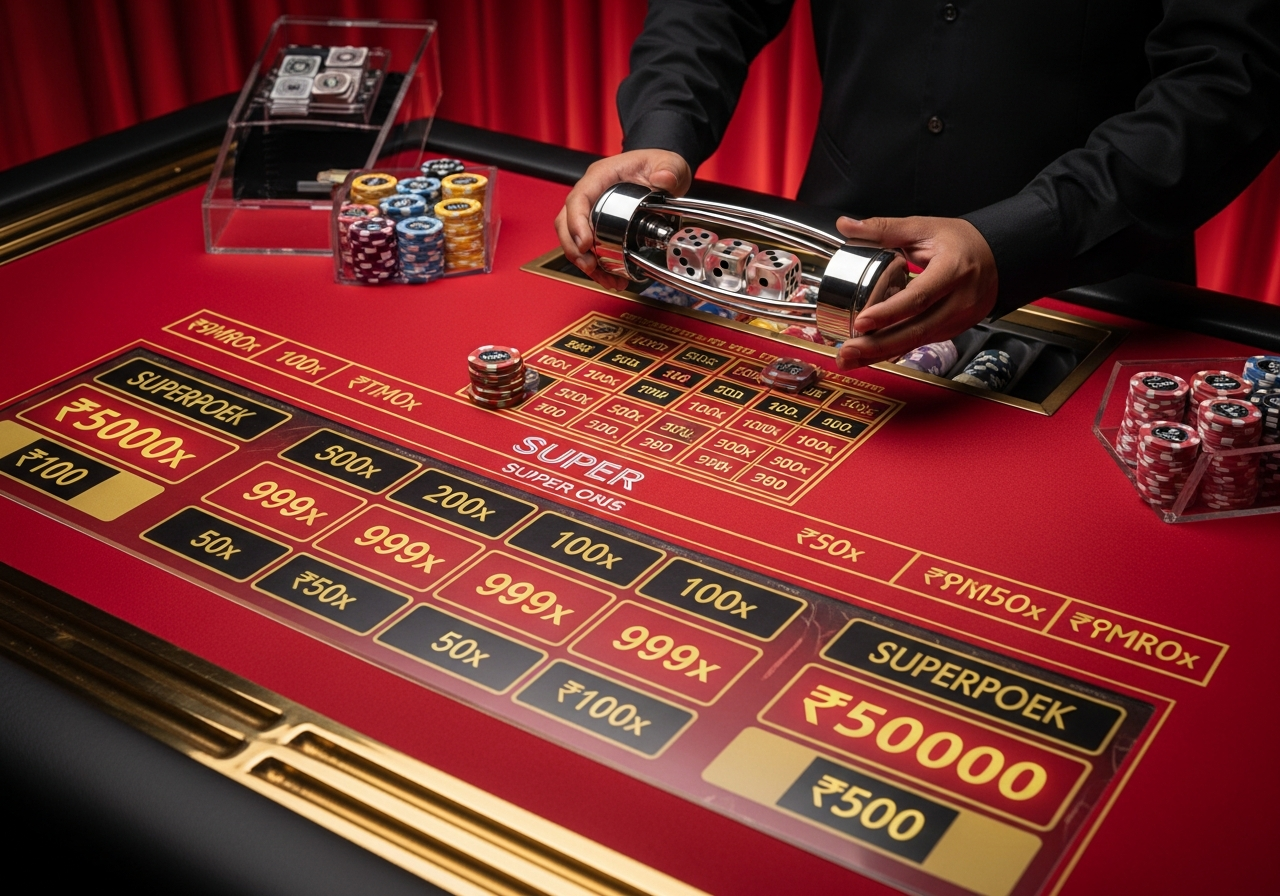
Super Sic Bo, developed by Evolution Gaming, has quickly become one of the most captivating live dealer games for Indian players. Unlike traditional Sic Bo, this variant introduces random multipliers that can transform a modest bet into a spectacular win—sometimes reaching up to 999 times your stake. But what exactly are these multipliers, how do they work, and most importantly, what does this mean for your bankroll and long-term play?
This guide breaks down Super Sic Bo’s mechanics in clear, practical terms designed specifically for Indian players betting in INR. You’ll learn how multipliers affect volatility rather than your expected returns, explore payout tables across all bet categories, discover which bets qualify for multiplier boosts, and gain actionable strategy insights to help you play responsibly and enjoyably.
What Is Super Sic Bo And Why It’s Different For Indian Players
Super Sic Bo maintains the classic three-dice foundation of traditional Sic Bo but adds a modern twist: random multiplier assignments that occur after betting closes but before the dice are rolled. Streamed live from an oriental-themed Evolution Gaming studio, the game combines the social appeal of a live dealer with the excitement of unpredictable payout multiplication.
The core difference is volatility. Standard Sic Bo offers fixed payouts for every winning outcome. Super Sic Bo randomly selects certain bet spots on the table and applies multipliers—sometimes 2x, sometimes 50x, and occasionally as high as 999x for specific outcomes. This doesn’t improve your mathematical edge (RTP remains roughly consistent), but it dramatically changes how wins and losses feel during play. A ₹500 bet on triple sixes might return ₹1,500 under normal rules, but with a 200x or 999x multiplier, that same bet could yield ₹100,000 or more.
Indian-facing casinos offer Super Sic Bo with chip denominations ranging from ₹20 to ₹10,000, making the game accessible across different bankroll sizes. The game operates within regulated frameworks at most reputable platforms, though players should always verify their chosen casino’s licensing and responsible gaming policies.
Standard Sic Bo Basics: Dice, Bets And Table Layout
Traditional Sic Bo revolves around predicting outcomes when three dice are rolled. The table layout includes numerous betting spots: Big and Small bets (predicting whether the total will be in the 11–17 or 4–10 range), Odd and Even predictions, specific totals (4 through 17), doubles (two dice showing the same number), triples (all three dice matching), and combination bets (any two specific numbers appearing on the dice).
Super Sic Bo uses an identical grid structure and bet categories. The main overlay is the random multiplier feature, which applies only to certain designated bets—notably excluding Big/Small and Odd/Even, which remain fixed at 1:1 payouts.
How Super Sic Bo Fits Into The Indian Live Casino Landscape
Indian players have grown familiar with live roulette, live baccarat, and live blackjack, but Super Sic Bo offers a distinctly different risk and reward profile. While roulette is purely luck-based and baccarat follows rigid rules, Sic Bo’s multiple bet types create a sense of control and strategic choice—even though outcomes remain entirely random.
The multiplier mechanic enhances this appeal by introducing occasional “jackpot moments.” A ₹1,000 bet on a triple might normally pay ₹150,000 (150:1 odds), but with a 999x multiplier, it could yield ₹999,000. These rare, tantalizing outcomes drive engagement, but they can also fuel chasing behaviour if not managed carefully.
Responsible play means treating multipliers as occasional entertainment moments rather than income opportunities. Setting betting limits in INR—for example, capping daily losses at ₹5,000 or ₹10,000—helps maintain healthy play habits.
How Super Sic Bo Random Multipliers Work Step By Step
Understanding the round mechanics is essential to managing expectations and avoiding impulsive decisions. Here’s how each round unfolds:
- Betting window opens: Players select their bets on the on-screen grid and confirm stake amounts in INR (or their preferred currency).
- Betting closes: After a set countdown (typically 10–15 seconds), no new bets are accepted and existing bets are locked.
- Multipliers are assigned: Before the dice shake, the game randomly selects certain bet spots and overlays multiplier values. Some bets might see 2x, others 100x, and a few may receive the headline 999x multiplier.
- Dice are shaken: The live dealer shakes the three dice in a physical shaker on camera.
- Results are declared: The outcome is announced and displayed on the table.
- Payouts are calculated and credited: Any winning bets receive their standard payout, multiplied if a booster was assigned to that spot.
If your chosen bet did not receive a multiplier and it wins, you receive the standard payout. If it receives a multiplier but loses, you lose your stake as usual. The multiplier only benefits you if both conditions are met: your bet spot is boosted AND the dice outcome matches your prediction.
Key Rules Of The Multiplier Feature
- Random assignment: Multipliers are assigned at random each round; there’s no pattern or way to predict which spots will be boosted.
- Limited per round: Not all bet spots receive multipliers. Typically, a subset of available bets (often 5–15) are selected for boosting in each round.
- Visible before rolling: Players see which spots are multiplied after betting closes but before the dice roll, allowing informed decisions if the game permits late confirmation (though most do not).
- Big/Small and Odd/Even excluded: These even-money bets never receive multipliers and always pay 1:1 if they win.
- Bet-specific caps: Each bet type has a maximum multiplier ceiling. For example, specific triples might cap at 999x, while certain totals may cap at 100x.
- Multiplier must match outcome: If your multiplied spot doesn’t hit, the boost is wasted; conversely, if it does hit, the multiplier compounds your standard payout.
Super Sic Bo Payout Ranges And Multiplier Limits By Bet Type
| Bet Type | Regular Payout | Maximum Multiplier Payout | Multiplier Eligible |
|---|---|---|---|
| Big (11–17) | 1:1 | 1:1 | No |
| Small (4–10) | 1:1 | 1:1 | No |
| Odd | 1:1 | 1:1 | No |
| Even | 1:1 | 1:1 | No |
| Total 4 or 17 | 50:1 | Up to 500:1 | Yes |
| Total 5 or 16 | 25:1 | Up to 250:1 | Yes |
| Total 6 or 15 | 18:1 | Up to 180:1 | Yes |
| Total 7 or 14 | 12:1 | Up to 120:1 | Yes |
| Total 8 or 13 | 8:1 | Up to 80:1 | Yes |
| Total 9 or 12 | 6:1 | Up to 60:1 | Yes |
| Total 10 or 11 | 6:1 | Up to 60:1 | Yes |
| Specific Double (e.g., 1-1) | 10:1 | Up to 100:1 | Yes |
| Any Double | 8:1 | Up to 80:1 | Yes |
| Specific Triple (e.g., 6-6-6) | 150:1 | Up to 999:1 | Yes |
| Any Triple | 24:1 | Up to 200:1 | Yes |
| Combination (e.g., 1-2, any order) | 6:1 | Up to 60:1 | Yes |
Even-Money Bets Versus High-Multiplier Bets
Big/Small and Odd/Even bets represent the “safe” tier of Super Sic Bo. They hit roughly 50% of the time and pay 1:1, meaning a ₹1,000 bet returns ₹2,000 if it wins. These bets will never receive multipliers, so their volatility remains low and predictable. They’re ideal for players seeking steady, frequent small wins and are often used as a foundation for longer play sessions.
High-multiplier bets like specific triples, edge totals (4, 5, 16, 17), and certain combinations hit far less frequently but offer explosive payouts when they do. A ₹500 bet on triple sixes normally yields ₹75,000, but with a 999x multiplier could return ₹499,500—a life-changing outcome if you’ve wagered small. However, most rounds you’ll lose that ₹500 stake.
The choice between these bet categories primarily affects your session’s volatility and emotional arc rather than your mathematical expectancy. Both approaches can be sustainable if bankroll is managed correctly.
Specific Triples, Any Triple And Combination Bets
Specific triple bets (predicting all three dice show the same number, such as 1-1-1 or 6-6-6) are among the rarest and highest-paying outcomes in dice games. The regular payout is 150:1, meaning ₹100 becomes ₹15,000. With a multiplier applied, that same ₹100 stake could return ₹149,900 (at 999x)—the headline fantasy scenario that attracts multiplier chasers.
Any Triple bets let you win if any triple appears, regardless of which number. This is more frequent than a specific triple but pays less per occurrence (24:1 standard, capping around 200x with multipliers). A ₹1,000 Any Triple bet might yield ₹24,000 normally or ₹200,000 if boosted.
Combination bets cover two specific numbers in any order (e.g., “1 and 2” can appear as 1-2-X, 2-1-X, or X-1-2, where X is any other number). These have mid-range hit frequencies and standard 6:1 payouts, boosted to around 60:1 under multipliers. For a ₹500 stake, a boosted combination win might return ₹30,000.
These bets are best approached as occasional, entertainment-focused shots rather than core steady-play vehicles.
RTP, Volatility And House Edge With Multipliers
Super Sic Bo’s theoretical RTP (return to player) varies by bet category but typically ranges from 88% to 96% depending on the specific bet and operator implementation. For example, Big/Small might return 97.2% over infinite spins, while specific triples average around 88–90% when accounting for the fixed and variable multiplier distribution.
The critical insight is that multipliers don’t improve RTP; they redistribute it. A specific triple that normally pays 150:1 has a house edge of roughly 7.1%, meaning the game keeps about 7.1% of all wagered funds on that bet long-term. Adding random 999x multipliers to occasional outcomes doesn’t change this percentage—it just creates wider swings. Some players will hit a 999x and leave with a fortune; most will simply lose their stake waiting for that outcome.
Volatility—the variation in short-term results—increases dramatically with multipliers. Big/Small bets have low volatility; you win or lose roughly ₹1 per rupee staked frequently. Specific triple bets have extreme volatility; you lose your stake 216 times out of 217 rolls on average, then occasionally hit and receive a massive payout (with or without multiplier).
Why Multipliers Feel Attractive But Don’t Change The Maths
- Availability heuristic: The game prominently displays “999x” in marketing, making large outcomes feel common, even though they occur in a tiny fraction of rounds.
- Recency bias: If you see another player win a 500x multiplier, you might feel like multipliers are “hot” that session, increasing your urge to chase.
- Hope and control illusion: Watching the multiplier appear on your bet spot after you’ve wagered creates a sense of luck or timing, even though you had zero influence.
- Loss of perspective: A ₹10,000 loss after missing a boosted triple can feel worse than a steady ₹1,000 loss from even-money bets, even though the latter is more typical and manageable.
Understanding these cognitive patterns helps you maintain emotional distance from multiplier outcomes and avoid spiral betting.
Playing Super Sic Bo: Betting Flow And User Interface
The on-screen interface displays a large dice shaker on the left and the betting grid on the right. The grid shows all available bet spots, with colour coding and labels for clarity. Once multipliers are assigned, they appear as bold numbers overlaid on the selected spots (e.g., “2x,” “50x,” or “999x”). The live dealer or avatar narrates the round and confirms outcomes.
- Review available bets: Study the grid and identify which bets appeal to your session plan (safe, medium-risk, or aggressive).
- Select your bet spot: Click on the bet location and confirm your stake in INR chips.
- Review and confirm: Most interfaces show a confirmation screen. Verify your bets and stake totals before confirming.
- Await multiplier announcement: After betting closes, watch the multiplier phase. You’ll see which spots light up with booster values. Note whether your chosen bets received multipliers.
- Observe the dice roll: The dealer shakes the three dice, and the result is called out.
- Check your outcome: Winning bets are highlighted, and payouts are calculated and added to your balance in real-time.
Chip Values, Table Limits And INR Examples
Most Indian-facing casinos offer chip denominations of ₹20, ₹50, ₹100, ₹500, ₹1,000, ₹5,000, and ₹10,000. Minimum table bets typically start at ₹20–₹100, while maximum total exposure per spin ranges from ₹50,000 to ₹100,000 depending on the operator.
Example scenario: You have a ₹10,000 session bankroll. You might allocate ₹2,000 per round across three or four bets: ₹500 on Big, ₹500 on a total (e.g., Total 10), ₹500 on a combination, and ₹500 on a specific triple. If all lose, you’ve spent ₹2,000 and have ₹8,000 remaining. If the triple hits with a 100x multiplier, your ₹500 becomes ₹50,000, boosting your session profit significantly.
Conversely, if you place ₹2,000 on a single specific triple and it doesn’t hit (probability ~99.5% per roll), you lose ₹2,000 in one spin. This illustrates why diversification and smaller individual stakes often suit Indian players’ bankroll management preferences.
Instant Super Sic Bo: Faster Variant With Similar Multipliers
Instant Super Sic Bo accelerates the game flow by removing some animations and allowing rapid successive rolls—sometimes one every 10–15 seconds instead of 30–45 seconds in standard Super Sic Bo. The multiplier mechanism, payout table, and bet categories remain identical.
The faster pace amplifies volatility exposure. In one hour of standard Super Sic Bo, you might place 80–100 bets; in Instant, you could reach 200–250 bets. This increases decision pressure and the odds of encountering a large loss streak if your chosen bets don’t perform. The faster variant suits experienced players with strong tilt control and pre-set loss limits, but it can be risky for newer or emotionally reactive players.
Super Sic Bo Strategy Fundamentals For Indian Players
Effective Super Sic Bo play isn’t about “beating” the game—randomness ensures you can’t. Instead, strategy focuses on choosing bet categories that align with your risk tolerance, managing volatility exposure, and protecting your bankroll from emotional decisions.
- Set a daily loss limit in INR: Decide in advance the maximum you’re willing to lose on any single session (e.g., ₹2,000, ₹5,000, or ₹10,000) and stop playing once you reach it.
- Avoid chasing losses: If you’ve lost your session limit, do not increase bet sizes or switch to riskier bets hoping for a quick recovery.
- Treat big wins as session exits: If you hit a large multiplier win (e.g., a 200x or 500x boost), strongly consider ending your session on that high rather than staying to “play it back.”
- Diversify bet types per round: Rather than going all-in on triples, mix in safer even-money bets and mid-range totals to smooth volatility.
- Track results privately: Keep a simple log of your bets, wins, and losses to help you spot emotional patterns (e.g., “I chase triples after losses”).
- Use time limits alongside monetary limits: Set a maximum session length (e.g., 1 hour) and exit when time’s up, even if you’re ahead.
Remember: outcomes are entirely random. No system, pattern, or skill can guarantee profit. Play for entertainment, within your means, and with full acceptance that losses are part of the experience.
Balancing Safe Bets And Occasional Multiplier Shots
| Bet Style | Pros For Indian Players | Cons / Risks | Typical Use-Case |
|---|---|---|---|
| Conservative (Big/Small, Odd/Even) | High hit frequency (~50%), steady small wins, low volatility, easier bankroll management | No multiplier boosts, smaller per-win payouts, can feel repetitive | Steady foundation play; extending session length with limited funds |
| Moderate (Mid-range totals 8–12, Any Double) | Reasonable hit rates (10–20%), multiplier eligible, balanced risk-reward | Lower hit rates than even-money, can swing session momentum | Mixed-bag betting; core supplementary wagers |
| Aggressive (Specific triples, edge totals 4/5/16/17) | High multiplier potential (up to 999x), rare big wins feel exciting, limited downside (only ₹100–500 per bet) | Very low hit frequency (1% or less), often long dry spells, easy to chase after losses | Occasional “lottery ticket” attempts; entertainment-focused shots |
| Hybrid approach | Combines steady play with jackpot moments, manages volatility, matches varied player preferences | Requires discipline to maintain bet allocation across categories | Recommended for most Indian players |
Understanding Specific Bet Categories And Multiplier Behaviour
| Bet Category | How Often It Hits | Typical Payout Range | Multiplier Impact | Recommended Usage |
|---|---|---|---|---|
| Big/Small | Very frequently (~50%) | 1:1 | None | Steady base wagering |
| Odd/Even | Very frequently (~50%) | 1:1 | None | Steady base wagering |
| Total 10 or 11 | Frequently (~12.5%) | 6:1 (standard) | Up to 60:1 | Core wager spot |
| Total 7 or 14 | Fairly often (~12.5%) | 12:1 (standard) | Up to 120:1 | Strong secondary bets |
| Total 4, 5, 16, or 17 | Rarely (~7–9%) | 25–50:1 (standard) | Up to 250–500:1 | Occasional higher-risk shots |
| Any Double | Occasionally (~7.4%) | 8:1 (standard) | Up to 80:1 | Mixed session wagers |
| Specific Double | Rarely (~2.8%) | 10:1 (standard) | Up to 100:1 | Occasional targeted bets |
| Any Triple | Rare (~1.4%) | 24:1 (standard) | Up to 200:1 | Occasional lottery-style shots |
| Specific Triple | Very rare (~0.46%) | 150:1 (standard) | Up to 999:1 | Rare, entertainment-focused “jackpot” attempts |
| Combination (2-number) | Occasionally (~7.4%) | 6:1 (standard) | Up to 60:1 | Mixed session wagers |
Totals 4–17: Sweet Spot Between Risk And Reward
Middle-range totals like 7 through 14 offer a balance many Indian players prefer. Total 10 and Total 11 hit around once every 8 rolls, pay 6:1 standard, and can reach 60:1 with multipliers. A ₹1,000 bet on Total 10 might return ₹6,000 normally or ₹60,000 if boosted—a significant but not life-altering swing.
Edge totals (4, 5, 16, 17) are rarer but higher-paying. Total 4 or 17 hit roughly once every 10–12 rolls and pay 50:1 standard, scaling to 500:1 under multipliers. A ₹500 bet becomes ₹25,000 normal or ₹250,000 boosted. These totals suit players seeking occasional bigger shots without the extreme variance of triples.
Many experienced Indian players sample a mix: ₹500 on Total 10, ₹300 on Total 15, and ₹200 on a combination bet per round. This diversification ensures frequent small wins, moderate occasional wins, and rare big hits—a rhythm that sustains engagement and session longevity.
Single, Double And Triple Number Bets
Single-number bets (predicting if a specific number appears on any of the three dice) pay 1:1, 2:1, or 3:1 depending on how many times that number appears. For instance, if you bet on “3” and the roll is 3-5-6, you win 1:1; if it’s 3-3-5, you win 2:1; if it’s 3-3-3, you win 3:1. These bets are not prominently featured in most Super Sic Bo layouts but can appear in extended rule sets.
Double bets (two dice showing the same number) hit around 7.4% of the time across any double, or 2.8% for a specific double (e.g., 4-4). Any Double pays 8:1 standard, boosted to 80:1; Specific Double pays 10:1, boosted to 100:1. These are mid-volatility bets suitable for secondary wagers.
Triple bets are the headline multiplier vehicles. Specific Triples (all three dice the same) pay 150:1 standard, reaching 999:1 under multipliers. Any Triple (any three matching) pays 24:1, reaching around 200:1. These are ultra-high-variance bets, losing 216+ times before the occasional hit, but when they do connect—especially with a multiplier—they deliver life-changing returns.
Common Mistakes, Myths And How To Avoid Them
- Mistake: Assuming multipliers improve expected value. Many players believe that because multipliers exist, they’ve found an edge. In reality, multipliers are randomly distributed and don’t shift RTP in your favour. Avoid this by studying payout tables and understanding that house edge remains constant.
- Mistake: Betting heavy on triples hoping for a 999x multiplier. This is a core chasing behaviour. Triples hit roughly once per 216 rolls; waiting for one with a multiplier means expecting to lose 216+ stakes repeatedly. Instead, treat triples as tiny, occasional entertainment bets (₹100–₹300 per round) and build your session on stronger bets.
- Mistake: Doubling or increasing bets after losses to “recover” in one big win. This is the classic gambler’s fallacy and spiral. Each roll is independent; a prior loss doesn’t increase your chances of winning the next spin. If you’ve lost your session limit, stop playing entirely.
- Myth: “Hot” and “cold” numbers. Some players believe certain numbers or totals are due to hit because they haven’t appeared recently. Dice outcomes are completely random; past results don’t influence future rolls. A number that hasn’t appeared in 20 rolls is no more likely to appear on roll 21.
- Myth: Dealer influence or predictability. Some live casino players imagine that dealers can “control” dice outcomes or that observing their technique reveals patterns. Modern live dealers follow strict protocols; outcomes are purely mechanical and random. Any perceived pattern is coincidence.
- Mistake: Playing without loss or time limits. Unlimited play, especially in fast-paced Instant Super Sic Bo, increases loss exposure and tilt risk. Always set a daily loss cap (e.g., ₹5,000) and a session duration (e.g., 60 minutes).
Tilt Control And Session Management For Indian Players
Tilt—emotional decision-making after frustration, loss, or excitement—is the leading cause of sessions spiralling into serious losses. After missing a 999x multiplier on a triple you wagered on, or after a rapid loss streak, you might feel a compulsive urge to “make it back” with a large bet or aggressive play.
Practical tilt-control tactics:
- Pause after big swings: If you’ve just experienced a significant loss or win, take a 5–10 minute break. Step away from the screen, get water, or check your email before resuming.
- Use loss limits religiously: If your limit is ₹5,000 per session and you’ve lost ₹4,800, restrict yourself to bets no larger than ₹200 in your final round. Stop at ₹5,000 regardless of excitement or urges.
- Set a “walk-away” profit target: If you’re ahead by ₹3,000, consider quitting and locking in the win. Returning to play “one more round” often erases gains.
- Recognize tilt signals: Increased heart rate, frustration, self-talk like “just one more bet,” or reaching for more funds are signs you’re tilting. Pause or stop immediately.
- Use session notes: After playing, jot down your mood, decisions, and outcomes. Over time, you’ll spot your personal tilt patterns (e.g., “I always chase triples after even-money bets lose”).
Advanced View: Maths Behind Super Sic Bo Multipliers
At the foundation, Super Sic Bo operates on the same probability model as standard Sic Bo: three dice, each with six faces, yielding 216 possible outcomes (6³). Your odds of rolling a specific total or combination are fixed and unchanging across rounds.
For example, rolling a total of 10 has 27 possible outcome combinations out of 216, so the probability is 27/216 = 12.5%. If the regular payout for Total 10 is 6:1, then over infinite rounds, you’d expect to win ₹6 for every ₹1 wagered 12.5% of the time, while losing your stake 87.5% of the time. This nets to an RTP of approximately 97.2% (meaning the house edge is 2.8%).
Multipliers modify only the payout numerator, not the probability. If a 10x multiplier lands on your Total 10 bet, you now win 60:1 instead of 6:1—but this still happens only 12.5% of the time. The house carefully caps multiplier ceiling values so that the long-term RTP remains within their target range (typically 88–97% depending on bet type).
When Multipliers Can Create Positive EV (And Why You Still Can’t Exploit It)
Expected Value (EV) is calculated as (probability × payout) − (probability of loss × stake). For Total 10 at 6:1, standard EV per ₹1 wagered is (0.125 × 6) − (0.875 × 1) = 0.75 − 0.875 = −0.125, or −12.5%. This is negative, confirming the house edge.
If a multiplier boosted Total 10 to 100:1, the momentary EV becomes (0.125 × 100) − (0.875 × 1) = 12.5 − 0.875 = +11.625, a massive positive EV. If you could bet only on multiplied outcomes, you’d profit long-term.
However, you cannot: multiplier assignments are random and made after betting closes. You place your bet not knowing whether it will be multiplied. Once multipliers appear, betting is locked, so you cannot adjust your stake. This means multipliers feel like windfalls or missed opportunities but never opportunities you can actively leverage for profit.
Comparing Super Sic Bo To Other Multiplier Games
| Game | Type | Max Multiplier | Core Mechanic | Player Experience |
|---|---|---|---|---|
| Super Sic Bo | Live Dice | 999x | Three dice, random post-bet multipliers | High volatility, occasional jackpot shots |
| Lightning Roulette | Live Roulette | 500x | Single roulette spin, random multipliers on specific numbers | Similar multiplier excitement, faster pacing |
| Lightning Dice | Live Dice | 1,000x | Single die roll, two dice roll, or three dice roll options with multipliers | Simpler than Sic Bo, pure luck focus |
| Dream Catcher | Live Wheel | 40x | Large wheel spin, monetary segments with multipliers | Slower, luck-driven, lower max multipliers |
| Mega Ball | Live Draw | 500x | Ball draw with multiplier selections | Lottery-style appeal, transparent odds |
Super Sic Bo occupies a unique middle ground: more complex than Lightning Dice or Dream Catcher but more familiar than some Asian-market-specific games. Its appeal to Indian players combines the strategic bet-selection feel of traditional table games with the excitement of multiplier potential, making it a compelling addition to any live casino offering.